Why Fast Money Ruins More Entrepreneurs Than Being Broke Ever Did
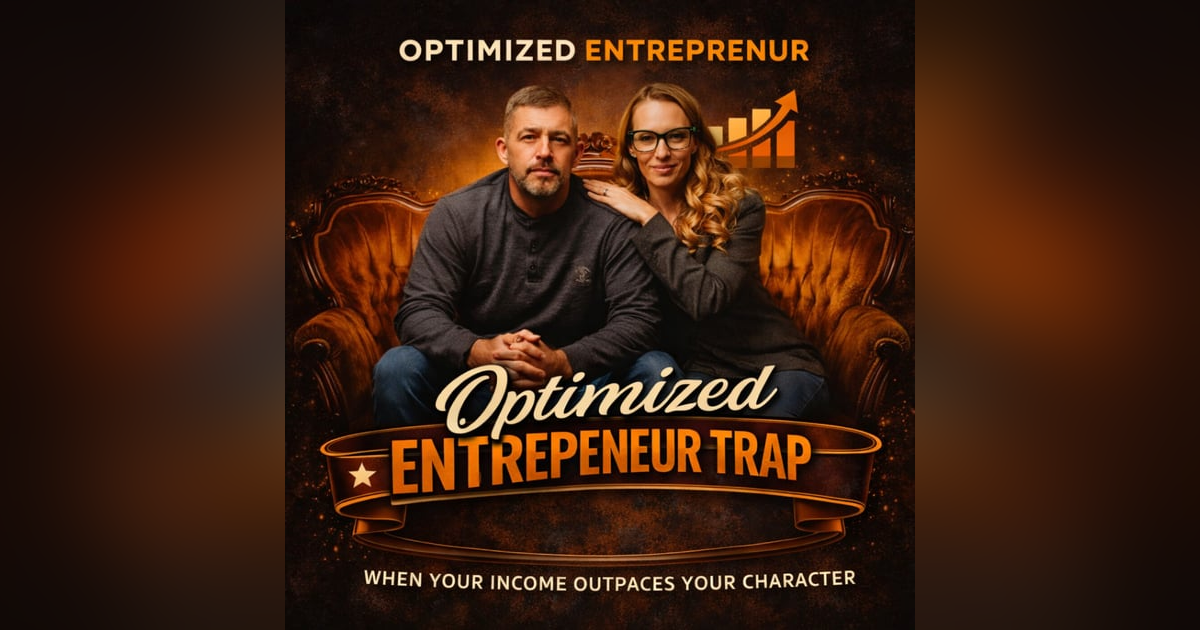
What happens when your income explodes before your character is ready to carry it?
In this episode of The Jeremy Hanson Podcast, Jeremy shares the true story of a 24-year-old entrepreneur who went from $55,000 a year to over $750,000 in revenue in under twelve months — and watched his marriage, integrity, and discipline collapse under the weight of money he wasn't prepared to handle.
This isn't a story about failure. It's a story about a gap — the dangerous gap between what you earn and who you are.
Jeremy breaks down the real data on fast money and financial collapse (including what lottery winner research reveals about rapid wealth and bankruptcy), explores how money functions as a magnifier of character — for better and for worse — and delivers a five-rule practical framework for building the discipline, identity, and systems you need before the money hits.
If you're building a business right now, this episode could be the most important thing you listen to this year. Because making money is not the hard part. Surviving it — with your life, your family, and your integrity intact — that's the game nobody's teaching.
Tactical. Real. No guru fluff. That's The Jeremy Hanson Podcast.
Visit www.jeremyhanson.pro and www.optimized1.com for more.
He went from $55K to $750K in one year — and it destroyed his life. Jeremy breaks down the entrepreneur trap nobody talks about.
- entrepreneur podcast
- business mindset
- fast money dangers
- entrepreneurship failure
- money and character
- business growth mistakes
- entrepreneur trap
- income and discipline
- wealth mindset podcast
- small business lessons
- entrepreneur success
- business lifestyle inflation
- money management entrepreneur
- building a business
- Jeremy Hanson podcast
- what happens when entrepreneurs make money too fast
- why fast money ruins entrepreneurs
- income without identity entrepreneur
- how rapid business growth destroys personal life
- entrepreneur discipline before success
- lottery winners go broke statistics podcast
- money as a magnifier character
- how to handle fast business income
- entrepreneur trap nobody talks about
- when revenue outpaces discipline
- lifestyle inflation small business owners
- entrepreneur marriage and money problems
- building character before wealth
- blue collar entrepreneur success story
- how to prepare for business success
- revenue vs profit mindset entrepreneur
- Jeremy Hanson optimized entrepreneur podcast
- why entrepreneurs lose everything after success
- entrepreneur identity and income gap
- scaling a business without losing yourself
Why do some entrepreneurs lose everything after making a lot of money? A: Many entrepreneurs lose everything after rapid income growth because their character and financial systems weren't built to handle the load. Fast money skips the slow, grinding process that builds discipline, decision-making instincts, and respect for wealth. When money arrives faster than the character development that normally accompanies it, the foundation cracks. Studies on lottery winners show this pattern clearly — larger winners are statistically more likely to go bankrupt within five years than smaller ones, because the money arrived without the framework to sustain it.
What is the entrepreneur income trap? A: The entrepreneur income trap is the dangerous gap between how much money a business owner earns and who they are as a person. When income grows faster than discipline, identity, and character, the entrepreneur is carrying more weight than their foundation can support. This often results in lifestyle inflation, poor financial decisions, relationship breakdown, and ultimately, loss of both the business and the life they were trying to build.
Do lottery winners really go broke? What does the research say? A: Yes — research supports the pattern of lottery winners experiencing financial collapse after winning. A study published in the Review of Economics and Statistics analyzing Florida lottery winners found that larger prize winners were actually more likely to declare bankruptcy within three to five years than smaller prize winners. The reason: sudden wealth without the discipline, systems, or identity built to sustain it leads to spending patterns and decisions that rapidly erode the windfall.
How does money change a person? A: Money functions as a magnifier — it amplifies who you already are, for better or worse. Disciplined, generous, and focused people tend to become more of all three with access to wealth. Undisciplined, insecure, or reckless people tend to accelerate those tendencies when money arrives. The direction of change is determined almost entirely by who a person is before the money shows up, which is why building character before chasing income is the most important work an entrepreneur can do.
What is lifestyle inflation and why is it dangerous for entrepreneurs? A: Lifestyle inflation is the tendency to increase personal spending as income rises. For entrepreneurs, it's dangerous because it creates a false picture of financial health — revenue can look impressive while profit evaporates into trucks, equipment, upgraded housing, and elevated social spending. When revenue drops (and it always does at some point), lifestyle costs don't automatically scale back, leaving the business and personal finances in crisis.
What is the difference between revenue and profit for small businesses? A: Revenue is the total money a business brings in before any expenses are subtracted. Profit is what remains after all costs — materials, labor, overhead, equipment, and operating expenses — are paid. Revenue is the loudest number in business and the one most often cited in success stories, but profit is what actually determines financial health and sustainability. Many businesses with impressive revenue figures operate on thin or negative margins, which is why Jeremy Hanson emphasizes: don't celebrate revenue — celebrate profit.
How do I know if I'm financially ready to scale my business? A: You're ready to scale when your systems, team, and personal capacity can support the increased load — not just when the opportunity exists. Before scaling, ask: Do I have documented processes that don't require me in every decision? Do I have a team capable of delivering quality at greater volume? Do I have the financial reserves to absorb the costs of growth before the revenue catches up? If the answer to any of these is no, the more responsible path is to build the infrastructure before taking on the volume.
Why is discipline more important than opportunity for entrepreneurs? A: Opportunity without discipline produces revenue. Discipline without opportunity still builds something durable. The entrepreneurs who outlast the most talented people in their industry are almost never the most gifted — they're the most consistent. Discipline determines how you handle money when it comes in, how you treat clients when you don't need them, how you show up for your family during pressure seasons, and how you make decisions when no one is watching. Those invisible choices compound over time into either a sustainable business or an avoidable collapse.
How does fast business growth affect marriages and families? A: Rapid business growth is one of the highest-risk periods for marriages and family relationships. Income spikes bring new pressures, distractions, and temptations — and the ego reinforcement that often accompanies financial success can create distance between an entrepreneur and the people closest to them. The time and emotional bandwidth required by a fast-growing business frequently comes directly out of family presence. Without intentional protection of the home — treating family as the first business — rapid growth can be the catalyst for personal destruction even when the external metrics look impressive.
What does it mean that money reveals character? A: The phrase "money reveals character" refers to the way that financial resources — especially sudden or large amounts — remove the constraints that previously kept certain behaviors in check. When someone has limited money, survival priorities suppress many impulses. When money arrives in abundance, those constraints lift, and what was always underneath the surface becomes visible. Generosity, discipline, and integrity become more visible in people who already had them. Recklessness, insecurity, and poor values become more visible in people who didn't. Money doesn't create character — it exposes what was always there.
What are the warning signs that a business is growing too fast? A: Warning signs of unsustainable fast growth include: cash flow that can't keep up with expenses despite high revenue, leadership making reactive decisions without clear processes, team quality declining as hiring outpaces training, lifestyle spending increasing alongside revenue rather than profit, and personal relationships deteriorating due to time and energy demands. If revenue is growing but the owner feels more chaotic and stressed rather than more in control, the business is likely scaling beyond its current operational and personal capacity.
What should entrepreneurs do when their income suddenly increases significantly? A: When income spikes significantly, the most important moves are: resist lifestyle inflation immediately — live as if the income didn't change yet; intensify financial tracking to understand actual profit vs. revenue; build operational reserves rather than spending windfalls; deliberately invest in the discipline and systems that match the new income level; and protect the home — maintain intentional presence with family before it becomes a casualty of success. The goal is to let the character, systems, and habits catch up to the income before the income runs ahead of what the foundation can hold.
entrepreneur podcast, fast money dangers, business mindset, income and character, entrepreneur trap, lifestyle inflation, money and discipline, wealth mindset, small business advice, entrepreneurship lessons, business growth, entrepreneur failure, revenue vs profit, scaling a business, Jeremy Hanson, optimized entrepreneur, business podcast, entrepreneur success, financial mistakes, lottery winner statistics, money changes people, building wealth, character and success, entrepreneur discipline, business mistakes, blue collar entrepreneur, service business, construction business, entrepreneur marriage, family and business, money magnifier, entrepreneur identity, fast business growth, preparing for success, business sustainability
The Jeremy Hanson Podcast — Optimized Entrepreneur is the show for working entrepreneurs who are serious about building something real. Not theory. Not hype. Just the hard-won frameworks, real math, and honest conversations that the guru industry won't have with you. Hosted by Jeremy Hanson — 20+ year entrepreneur, syndicated broadcaster, and founder of multiple six-figure service businesses. New episodes at www.jeremyhanson.pro and www.optimized1.com.
"Money doesn't ruin people. It reveals them. And if you're not ready — it will expose every crack in your foundation." — Jeremy Hanson
"His character could not carry the weight of his income. That gap is where lives fall apart." — Jeremy Hanson, The Jeremy Hanson Podcast
"A lot of entrepreneurs are lottery winners who worked for their ticket. The money is real. The foundation isn't there yet." — Jeremy Hanson
"Don't celebrate revenue. Revenue is loud. Profit is quiet. Stability is everything." — Jeremy Hanson, Optimized Entrepreneur
"Grow your discipline faster than your income. If your money is outpacing your self-control — you are in danger." — Jeremy Hanson
00:00 — Cold Open: The $750K Collapse 02:15 — Introduction: What Nobody Teaches About Surviving Money 05:00 — Chapter 1: The Story — A 24-Year-Old and a Dream 10:30 — Chapter 2: The Rise — When the Money Flooded In 15:00 — Chapter 3: What the Data Says — Lottery Winners and the Fast Money Pattern 20:30 — Chapter 4: Money as a Magnifier — Both Sides 26:00 — ★ MIDROLL: Intuit QuickBooks Payroll 28:30 — Chapter 5: The Shift — Where It All Started to Change 33:00 — Chapter 6: The Break — Character vs. Income 37:00 — Chapter 7: Five Lessons That Could Save Your Life 46:00 — ★ MIDROLL: Zapier 48:30 — Chapter 8: The Hard Truth 50:30 — Chapter 9: The Framework — What To Do Instead 57:00 — Chapter 10: The Real Math 62:00 — Closing: Go Build Something Worth Keeping
See Privacy Policy at https://art19.com/privacy and California Privacy Notice at https://art19.com/privacy#do-not-sell-my-info.