Protecting Your Kids While You Build the Business — Part 2: Keeping the Promise

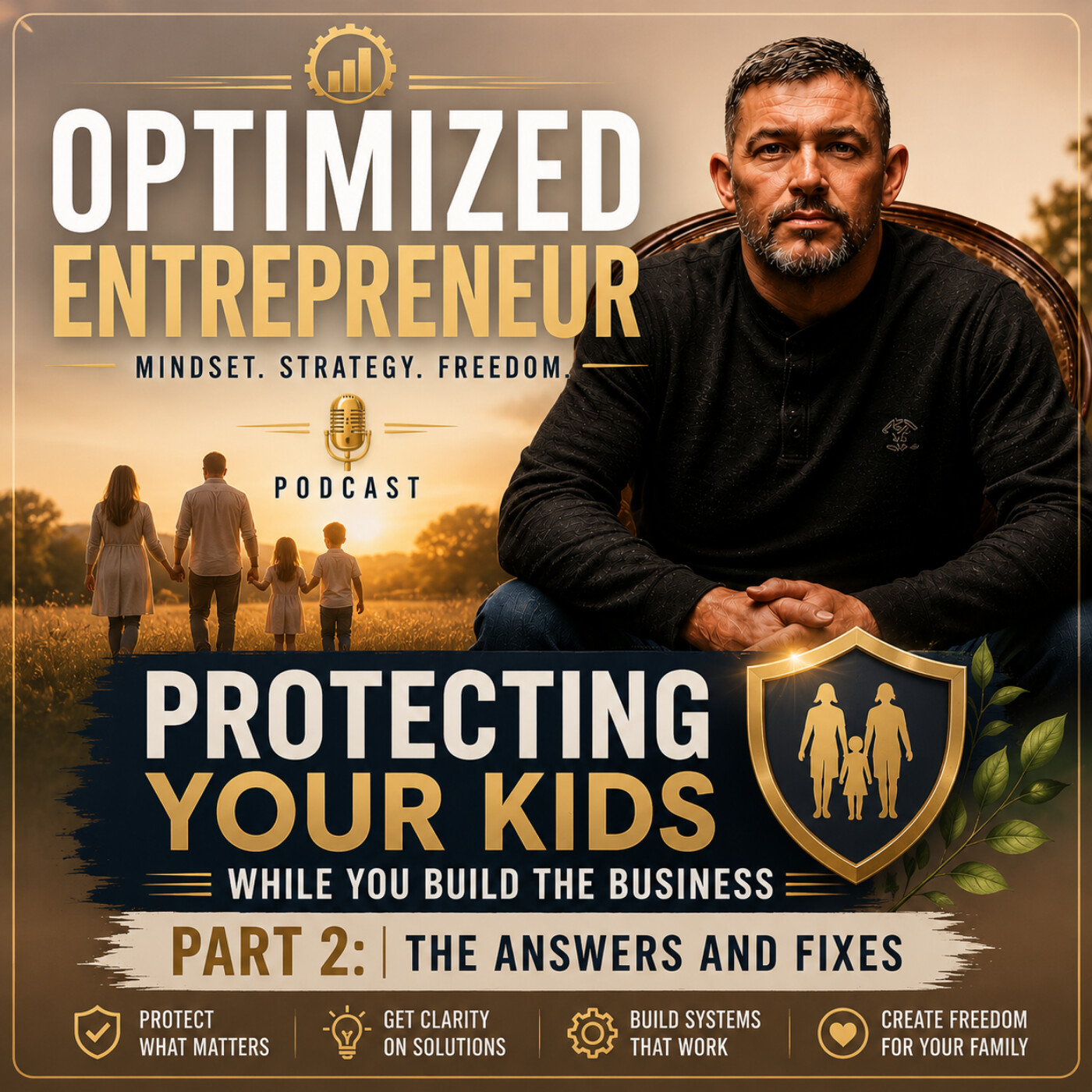
Protecting Your Kids While You Build the Business — Part 2: Keeping the Promise
EPISODE DESCRIPTION
Two scenes open this episode. A single mother at her kitchen table at 9:47 at night, laptop still open, kids asleep upstairs, missing bedtime for the third time this week and telling herself she had no choice — and missing the part of the truth that matters. A married father walking through the front door at 7:30 with the phone in his hand, kids glancing up at him briefly before going back to homework, and nobody in the house expecting him to stop. The family has already adapted to a version of him that does not stop. That is the part that should bother him most. Two different scenes. Same problem. Different shapes. Part 2 of the Optimized Entrepreneur series on protecting your kids while you build the business is the execution episode — the systems, the transitions, the practical moves you can install starting tonight. Jeremy Hanson opens with what he calls the deliberate close — the three-minute ritual that gets entrepreneurs out of work mode and into family mode without dragging the business into the room with you. He explains why the brain does not flip into family mode just because the physical location changed, and how externalizing the open loops onto paper gives the brain the reliability it needs to actually let go. From there he goes deep on single parent execution. Two anchor windows that are non-negotiable. The visible calendar that creates accountability through public commitment. The handoff ally network you build before you need it — not for everyday backup, for the rare emergency that would otherwise become a missed window with no covering adult. The repair conversation that follows a missed night, and why direct acknowledgment beats invisible guilt every time. And the often-overlooked discipline of building a small life outside of work and parenting, because depleted single parents become inconsistent ones. Then he turns to married parent execution and the team coordination that almost no entrepreneurial marriage actually has. The Sunday weekly sync that gives the household a regular forum to discuss its operational reality. The named division of labor that makes invisible carrying labor visible. The coverage commitment that turns parallel parenting into team parenting. And the fourth move — protecting the marriage itself with the same intention you protect the kids, because if the marriage hollows out the kids feel the temperature in the house and the protected windows lose their meaning. He gives a concrete example of a couple who actually run this operating system every week. Then come the hard scenarios. The genuine busy season and how to scale protections rather than abandon them, with explicit communication that names the bounded duration. The actual crisis and how the system bends without breaking — and why the failure mode is not the temporary absence but the failure to come back fully when the crisis passes. The scaling phase, which catches the most successful entrepreneurs, and why the opportunity-cost math feels backwards in the moment but the protected hour is the hour your kid keeps. And the hardest one — the kid who has stopped trying, the moment a kid does the math on whether bringing things to you is worth being half-heard, and how that calibration only reverses when the parent who caused it notices and starts again. The episode closes with the long view — what kids carry forward as adults from being raised by an entrepreneurial parent who held the line. Visit optimized1.com for the rest of the playbook.
CREDITS
Hosted by Jeremy Hanson. Produced by Fuzzy Life Studios. Distributed by Fuzzy Life Entertainment. Original music and sound design by Fuzzy Life Studios. For the rest of the playbook visit optimized1.com. Subscribe to the Built Different newsletter for both Optimized Entrepreneur and The Jeremy Hanson Podcast.
EPISODE METADATA
Show: Optimized Entrepreneur Episode Title: Protecting Your Kids While You Build the Business — Part 2: Keeping the Promise Series: Protecting Your Kids While You Build the Business Series Position: Part 2 of 2 Host: Jeremy Hanson Producer: Fuzzy Life Studios Distributor: Fuzzy Life Entertainment Sister Show: The Jeremy Hanson Podcast (jeremyhanson.pro) Joint Newsletter: Built Different Format: Solo narration Episode Type: Execution Spoken Word Count: 5,307 Estimated Runtime: 48–50 minutes Sponsors: None Website: www.optimized1.com
Q: What is the deliberate close and why does it work? Answer: It is a three-minute ritual where the entrepreneur writes down every open loop currently active in the business — the unresolved customer issue, the decision needed tomorrow, the follow-up scheduled for Wednesday — onto paper in a single trusted location. It works because the brain does not let go of important things until it knows they are captured somewhere reliable, and externalizing the loops gives the brain that reliability so the family layer can come back online when you sit down at the table.
Q: What are the two anchor windows for single parents? Answer: Dinner and the thirty minutes before bed. They are non-negotiable, daily, and protected even on the days when nothing else worked. The point of dinner is not the meal — it is the table, with no devices and conversation that can go where it needs to. The point of bedtime is the conversation that happens when the kid's guard is finally down.
Q: Why does the visible calendar matter for single parents? Answer: It gives the kid a tangible sense of when they have you, which reduces the underlying anxiety of not knowing whether this is a parent-around day. And it creates public accountability for the entrepreneur — when the calendar is on the wall and the kid can see it, you do not move that block for a customer call without the kid registering that you moved it.
Q: How do you build a handoff ally network? Answer: You have the conversation now, not in the moment of crisis. You ask grandparents, siblings, friends, or trusted neighbors directly — would you be available to step in for an evening when something blows up at work. People want to help. They are usually waiting to be asked. The single parent who never asks is also the single parent who has no covered emergencies.
Q: What is the weekly sync for married parents? Answer: A logistical, calendared, fifteen-minute conversation that happens at the same time every week and is specifically about the operational layer of the family — who has the kids when, what is on the calendar, where the business will push, where they need to adjust. It closes the gap between each parent's slightly different mental model of the family before that gap becomes resentment.
Q: What is the named division of labor and what does it accomplish? Answer: It is the explicit, on-paper agreement of who handles mornings, bedtime, school stuff, doctor stuff, lead and backup roles. Two things happen when it is named — the spouse who has been carrying invisible labor finally has it visible, and the entrepreneur who has been benefiting from it without realizing sees what their spouse has been doing. That awareness usually shifts behavior more than guilt-based conversations ever could.
Q: How do you handle a genuine busy season? Answer: You name the season out loud — bounded, with a finish line. A six-week season that is named feels different to a kid than the same six weeks of unexplained absence. Then you scale the protections rather than abandon them. Maybe you cannot do every dinner — you protect three dinners and they are non-negotiable. The reduced version of the protections is still the protections. The fatal move is going to zero protections during busy seasons, because that teaches kids the protections are conditional.
Q: What is the failure mode in a real business crisis? Answer: Not the temporary absence. The failure to acknowledge the absence, and the failure to come back fully when the crisis passes. The kid who watched a parent disappear into a crisis and never come back has experienced a kind of loss that is harder to repair than any single missed dinner.
Q: Why is the scaling phase the trap for successful entrepreneurs? Answer: Because the opportunity-cost math feels backwards in the moment — every protected hour feels like growth left on the table — but the protected hour is the hour your kid keeps and the marriage keeps. The entrepreneurs who hold the line through scaling are the ones who arrive at the other side of success with their family intact. The ones who do not arrive there alone.
Q: What is the kid-who-has-stopped-trying signal and how do you reverse it? Answer: A kid stops bringing things to you, stops telling you about their day, stops asking you to come to events. The parent often mistakes this for maturity. It is not. It is a calibration based on whether being half-heard is worth the disappointment. You reverse it by going to the kid directly — not in a guilt-loaded way that makes the kid comfort the parent, just directly — acknowledging what has happened and starting to show, over time, that you are the kind of parent they can bring things to.
Q: What is the long game from this two-part series? Answer: The kid you are raising right now becomes an adult, and that adult carries forward a felt orientation toward themselves and toward relationships. The kid who experienced consistent, present parenting carries a baseline that their experience matters. The kid who watched an entrepreneurial parent build something significant while still showing up for them carries a model of what an integrated life looks like — that ambition and presence are not opposites, that choosing the people you love is the only way the work actually means anything.
See Privacy Policy at https://art19.com/privacy and California Privacy Notice at https://art19.com/privacy#do-not-sell-my-info.